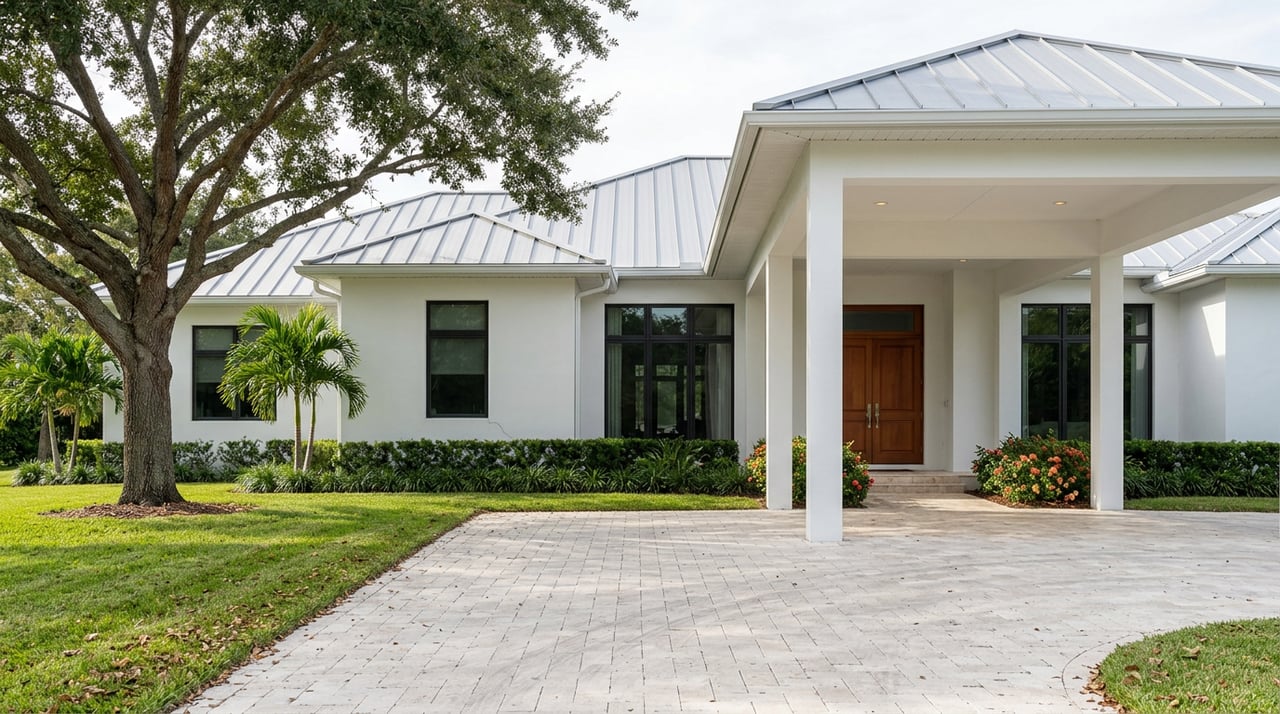
As Vero News reported, in a 65-day stretch between April 9 and June 12, 2026, two ONE Sotheby's agents working Vero Beach's barrier island signed 13 new luxury listing agreements worth more than $250 million. The properties ranged from an ocean-to-river estate offered at $60 million to a $35 million listing on Ocean Drive in Central Beach. Three of the homes sit in Indian River Shores, the town that contains John's Island.
Here is the detail that matters if you are trying to read this market from a browser tab: five of those 13 agreements are pocket listings. They will not appear in an MLS search. They will not turn up on a portal.
That single fact changes how you should read every other number in this piece.
Public Listing Data
As of late July 2026, the visible listings in John's Island presented an orderly picture: there were 8 active listings in the community, with an average list price near $1,544 per square foot, a median list price around $2.6 million, and an average of 161 days on market.
One hundred sixty-one days sounds like a slow market. It is not, or at least it is not only that. With a sample size of eight, one property that has sat since January can drag the average by weeks, and one that closes in nine days barely moves it at all. Days-on-market is a useful number in a market with hundreds of transactions to smooth out the noise. In a market this thin, it tells you more about which few houses happen to be listed right now than about how quickly buyers are moving.
The same caution applies to the median. A $2.6 million median list price is real, but a separate market report on the broader barrier island put current John's Island listings ranging from the low $2 millions up past $10 million, spanning oceanfront estates, riverfront compounds, and golf course homes. A single number cannot describe a market with that spread, and the community's brokers know it. That is why the median is best read alongside the range of listings.
Private Listings and Other Market Factors
The pocket listing is not a rounding error in this segment. It is closer to standard practice at the top of it.
The same Vero News reporting on the 65-day listing burst quoted one of the agents explaining why she was planning a three-day trip to Palm Beach, Fort Lauderdale, Boca Raton, and Miami to market the portfolio in person, agent to agent, rather than relying on the MLS. About 65 percent of that team's buyers come from South Florida, where the escalating price ceiling in Palm Beach and Miami is now pushing shoppers north to compare what they can get in Vero. For a seller at the very top of the market, going public on a portal can mean the wrong kind of attention. A private introduction to the right buyer's agent does the job with none of the exposure.
The same report named a dozen or so properties priced at $10 million or more currently on the market across John's Island, Windsor, and other island neighborhoods, with five of those north of $25 million. Some of that inventory is public. Some of it, by the nature of how these deals get done, never will be.
For a buyer relying on portal searches to gauge competition, those searches show public listings rather than pocket listings.
Why the National Rate Story Doesn't Apply Here
If you have been reading national housing coverage in 2026, you have seen the mortgage rate story play out in real time, rates easing, then climbing back toward 6.5 percent, with commentary about what that means for buyer power. It is a reasonable story for most of the country. It is close to irrelevant here.
Indian River County led the United States in 2025 in the share of home sales closed entirely in cash, at 62.7 percent, more than double the roughly 28 percent national average. That is a county-wide figure, not a John's Island-specific one, but John's Island sits at the price segment where cash dominance tends to run highest, not lowest. A buyer writing a check for a golf course estate is typically not waiting on a rate lock.
This is the part of the story worth sitting with. National coverage frames rate movement as the lever that opens or closes buyer activity. In a market where most of the competition is not financing at all, that lever is disconnected. Prices here do not track the 10-year Treasury the way a median-priced suburb does. They track scarcity, timing, and who happens to be looking at the moment a property, public or private, becomes available.
The Cap That Makes the Math Different
Every barrier island community in this part of Florida deals with limited land. John's Island's limits were not a market outcome. They were a design choice, made at the founding in 1969, when the club set out to build across 1,650 acres with a hard ceiling on density of roughly one residential unit per acre.
That distinction matters more than it sounds like it should. A community that is tight because demand outran supply can, in theory, loosen if a builder finds a way to add density. A community that capped itself by charter at its founding cannot. The scarcity in John's Island is not a phase of the cycle. It is the permanent condition the community was built to have, which is one reason its pricing has held up through periods when other segments of the Florida market cooled.
Club Membership and Rentals
Membership at John's Island Club is by invitation and subject to board approval, a separate track that runs alongside closing on the property itself. It is not automatic, and it is not guaranteed on any particular timeline tied to the closing date.
If you are weighing a rental before buying, the community's rental system requires three club member sponsors before a prospective renter can access the amenities that make John's Island what it is.
Club membership and rental requirements are separate considerations from a property's listing details. Buyers comparing John's Island with another gated barrier island community may also consider each community's process alongside price per square foot.
| Public listing data | Other market considerations |
|---|---|
| 8 active listings, $2.6M median list price (late July 2026) | An unknown number of pocket listings among the community's $10M+ inventory |
| 161-day average days on market | A sample small enough that one listing skews the whole average |
| Price per square foot across visible inventory | Board-approved membership, run on its own timeline |
| County-wide 62.7% cash-sale rate (2025) | A price segment where that share likely runs even higher |
Comparing John's Island with Other Communities
If you are comparing John's Island with Orchid Island, Sea Oaks, or another gated barrier island community, portal listings provide one point of comparison. The market data and community-specific property and membership considerations described above provide additional context.
A thorough due diligence process here involves two separate conversations: one about the property, and one about the club. Neither can be fully answered from a search bar.
If you are working through that comparison and want a straight read on what a specific John's Island property, or a comparable one elsewhere on the island, is actually worth against this market's real conditions, Team Provancher can walk you through both sides of it, the visible listings and the process that runs alongside them.
This article is general information, not legal, tax or financial advice. Consult a qualified professional about your situation.